Sydney Gay and Lesbian Mardi Gras lost $253,592 last financial year, eating into its financial cushion.
The deficit is revealed in Mardi Gras' annual report, which was released on Friday ahead of Saturday's annual general meeting. It reverses the $401,750 surplus reported a year earlier. Mardi Gras now says that surplus would have been a "significant deficit" without sponsorship money counted a year early.
Still, the result was better than the board had braced for. After reviewing its finances following the 2025 festival, the board budgeted for a $734,155 loss. Mardi Gras finished $480,563 better than that, helped by cost cuts, stronger-than-budgeted sponsorship and a surge in donations.
The loss has nonetheless taken a toll. Mardi Gras' net assets fell from $732,600 to $479,008. Net assets are everything an organisation owns minus everything it owes.
Mardi Gras operates through two companies: Sydney Gay and Lesbian Mardi Gras Ltd, which runs the festival, and Mardi Gras Arts Ltd, which employs management staff, runs the float workshop and handles fundraising and donations. Looked at on its own, the festival company now owes more than it owns.
The board has approved a budget forecasting a return to surplus in 2026–27, though the report describes it only as "modest" and doesn't give a figure.
Last year's surplus revisited
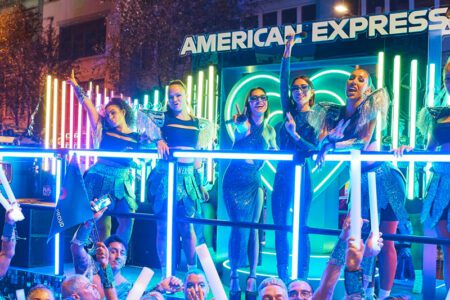
When Mardi Gras reported its 2024–25 surplus, it hailed the result as "a clear turning point" and a "financial turnaround". It credited the result to early sponsorship funds from then principal partner American Express. Amex has since ended its partnership with Mardi Gras.
This year's report is blunter about what that early money meant.
"Excluding this revenue, FY25 would have recorded a significant deficit and FY26 would have recorded a significant surplus," it says.
Last year's report said the early Amex funds pushed sponsorship $302,409 over budget. Neither report says how much was brought forward in total.
A smaller festival
Mardi Gras ran fewer events itself in 2026, and its revenue shrank. Revenue fell 36 per cent, from $10.61 million to $6.78 million, which the report puts down to the smaller program, lower sponsorship and the timing of revenue between years.
The biggest drop came from ticket sales, which fell 73 per cent to $711,321. After its financial review, the board took the Mardi Gras Party, the Kaftana and Paradiso pool parties, Ultra Violet, Sissy Ball and extra parade viewing areas out of the budget. It was no longer prepared to carry the upfront costs and risk of uncertain ticket sales.
Most of those events went ahead anyway, with outside partners taking the lead:
- City Recital Hall presented Ultra Violet.
- DJ Murphy ran the pool parties at Jimmy's Rooftop.
- Sissy Ball was staged in partnership with Inner West Council.
Mardi Gras recorded no revenue from Ultra Violet or the pool parties. Sissy Ball went through Mardi Gras' accounts, bringing in $98,041 against $97,902 in costs and breaking even.
Sponsorship and grants fell $1.29 million, to $4.23 million. In-kind support, which is goods and services that partners provide instead of cash, collapsed from $1.22 million to $235,476. The report lists no principal partner. Coles Group is the top-billed presenting partner.
Bar sales, which make up most of Mardi Gras' sale of goods, fell to $222,576, from $363,189. That was $67,424 below budget, which Mardi Gras blamed on rain at Fair Day.
"The result highlights the continued exposure of outdoor events to weather-related revenue risks," the report said.
There were bright spots. Donations and fundraising jumped more than tenfold to $491,353, driven particularly by the inaugural Mardi Gala Ball. Its philanthropy activities returned a net $343,900. Parade entry fees doubled to $133,061, and the Mardi Gras app was downloaded 8589 times.
The Party that wasn't
The Party, long one of the festival's biggest events, was cancelled in February, just weeks before the parade.
In the report, chief executive Jesse Matheson said the Party had faced "persistent financial challenges" since losing the Royal Hall of Industries as a venue. Despite "considerable efforts to develop a new model", rising costs and other setbacks meant going ahead would have exposed Mardi Gras to "unacceptable financial risk".
The numbers bear that out. Last year's Party brought in $1.36 million but still lost $143,161.
Despite being cancelled, the Party recorded a $46,077 profit in 2025–26 on $78,500 in revenue, according to the report's event-by-event breakdown. The report doesn't explain the figures.
"We want to see the Party return, but only through a model that respects its history, involves our community and is financially responsible," Mardi Gras directors and co-chairs Kathy Pavlich and Mits Delisle wrote. Mardi Gras has since announced the Party will return on March 6, 2027.
Glitter Club, the premium parade viewing area at Taylor Square, had its own setback. Changes to "licensing arrangements" in January cut about 600 tickets from its capacity.
Even so, Glitter Club's profit rose from $23,371 to $95,918. Its revenue dropped from $699,621 to $406,345, but its costs fell further.
Where the money went
Running a smaller festival cost far less. Event costs fell $3.38 million to $4.74 million, with the biggest savings in event staffing, infrastructure, venues and entertainment.
But staffing was also where the budget came unstuck. Event staffing costs ran $751,626 over budget, at $1.6 million against a budget of $851,101. Mardi Gras says it has identified "historical inconsistencies" in how staff costs were budgeted and split between events and the organisation.
That complicates the report's figure of $787,878 in overhead savings, which includes $513,364 saved on employee benefits. Adding event staffing and employee benefits together, staff costs came in about $238,000 over budget.
Employee benefits, which cover staff outside event delivery, rose 21 per cent to $1.6 million. Marketing costs rose nearly 50 per cent to $446,142.
Event by event
- Parade: net cost of $1.52 million, up from $1.42 million
- Fair Day: lost $474,821, up from $281,703
- Laneway: profit of $114,263, up from $74,636
- Glitter Club: profit of $95,918, up from $23,371
- Sissy Ball: broke even, with a $67 profit
- Workshop: lost $65,093, down from a $193,050 profit
- Mardi Gras Party: cancelled, but recorded a $46,077 profit
The financial position
Mardi Gras finished the year with $1,021,247 in the bank, down slightly from $1,072,182. But more than 40 per cent of that, $455,196, sits in a public fund for donations and can't be spent on day-to-day running costs.
Strip that out and Mardi Gras had $566,051 in cash it could use, down from $799,072. Its bills due within 12 months ($703,910) were slightly more than the assets it could draw on in that time ($699,555).
More money also flowed out of day-to-day operations than came in. Its day-to-day operations took in $50,935 less than they cost. The year before, they brought in $615,218 more than they cost.
The strain is clearest in the festival company itself. On its own, the festival company has negative net assets of $148,035. The organisation as a whole only owns more than it owes because Mardi Gras Arts has net assets of $627,043.
None of this suggests Mardi Gras is in immediate danger. It has no borrowings, and its auditor, EY, did not flag any material uncertainty about it continuing to operate. But with little spare cash outside its donation fund and no principal sponsor, it has little room for another bad year.
The co-chairs say the board must also examine its own decisions.
"We also recognise that financial challenges cannot simply be attributed to rising costs or a difficult sponsorship environment," Pavlich and Delisle wrote. "As a Board, we have a responsibility to examine our own decisions, strengthen financial oversight and ensure we're realistic about what the organisation can deliver."
Members and governance
The financial pressure came during a turbulent year in the boardroom.
The board voted to stand down then directors Luna Choo and Damien Nguyen on March 12, and stood Nguyen down a second time on April 28. Both were removed by members at July's extraordinary general meeting.
In their report, the co-chairs disclose complaints about "the involvement of external groups in membership activities". They also cite "concerns about the authenticity of some membership records".
Membership rose to 3370, from 3164, but revenue from it came in $22,312 below forecast. Mardi Gras says a key contributor was the EGM, which meant it couldn't run its usual end-of-financial-year membership drive.
Board attendance
The board met 22 times during the year, up from 18, and 11 directors served at some point.
Pavlich, Delisle and Diana McManus attended all 22 meetings. Jarrod Lomas and former director Louis Hudson, who left the board in November 2025, attended every meeting they were eligible for. Nguyen and Choo, who were stood down for part of the year, attended every meeting the report lists them as eligible for.
Treasurer Wendy Maloney had the lowest attendance rate on the board, attending 7 of 10 meetings. She also attended 4 of 5 Audit and Risk Committee meetings.
Former directors Luc Velez and Kyriakos Gold, who both left the board in November 2025, attended 10 of 13 and 11 of 12 meetings respectively. Velez attended 15 of 18 in 2024–25. Savanna Peake attended 8 of 10.

Ben Grubb is the founder and editor of Gay Sydney News, an independent publication covering LGBTQIA+ news. A journalist with more than 15 years' experience, he has reported and edited for The Sydney Morning Herald, The Age, WAToday, Brisbane Times, The Australian Financial Review, News.com.au, ZDNet, TelecomTimes and iTnews, primarily on the topic of technology. He previously hosted The Informer, a queer current affairs program on Melbourne’s JOY 94.9 radio station, and contributes to LGBTQIA+ media including Stun Magazine. Ben has also appeared as a technology commentator on Channel Ten's The Project, ABC RN’s Download This Show and commercial radio stations 2UE, 2GB and 6PR. Contact Ben: [email protected]